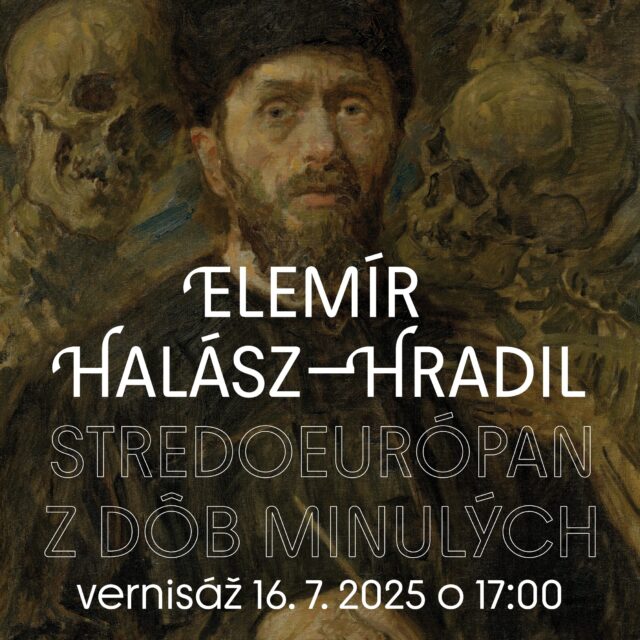
The exhibition project reprises the exposition output of two years of scientific-research activities exploring the life and work of the Košice artist Elemír Halász-Hradil, hitherto perceived marginally as a modestly progressive modernist who ranks among the classics of early modernism. Halász-Hradil’s painting was shaped at the turn of the 19th and 20th centuries, and the essence of his creative activity lies in following the legacy of plein-air painting imbued with post-impressionist tendencies and Central European luminism. Research into Halász-Hradil’s life and work began in 2021 with the establishment of contact with his direct descendants. His grandson in Prague and granddaughter in Budapest have carefully preserved his artworks for decades, affectionately referring to him as ‘grandpa’. An extensive exhibition and publication project was created thanks to the family’s enormous willingness and trust. The project introduced the public to lesser-known or previously unseen works and documentary materials. The exhibition was conceived as a reflection of human life in times of changing geopolitical structures and cultural influences. In 2023, the East Slovak Gallery symbolically commemorated the 150th anniversary of the birth of this important Košice artist and educator. Born during the times of the monarchy, Halász-Hradil witnessed significant societal changes, including the First World War, the disintegration of the monarchy, and the establishment of the new Czechoslovak state. The stories of these difficult times are told in his artwork.
Elemír Halász-Hradil was born in Miskolc in 1873. Various circumstances connected with geopolitical changes at the beginning of the 20th century resulted in his relocation to Košice, where he ultimately settled and lived until his death in 1948. Halász-Hradil was renowned in Košice as a highly sought-after portrait artist. He also received several official commissions from the city. For instance, he painted official portraits of the city’s mayors, as well as a panoramic view of Košice from the east, which still adorns the premises of the Old Town Hall. Halász-Hradil was an important figure in the city’s cultural fabric. He also worked as a teacher, passing on his talent to pupils at the Dry Mill on Zbrojničná Street, which is now known as the Rotunda. He had his studio there too, which he shared with his colleague Ľudovít Csordák for some time. Halász-Hradil’s works often appeared in various group exhibitions, particularly during the interwar period at the East Slovak Museum, where he also held a solo exhibition. In 1908, he exhibited at the Great Hungarian Exhibition in London, where the English public were introduced to the Kingdom of Hungary’s artistic and commercial production. The talented artist was born Elemír Hradil. His father, Václav, was from Bohemia and his mother, Magdolna, was Austrian. In 1902, Hradil applied to Count Andrássy for financial support in the form of a scholarship. His friends advised him to change his surname to make it sound more Hungarian. He therefore added the more Hungarian-sounding ‘Halász’ to his surname. Thanks to the scholarship, Halász-Hradil spent a year studying in Paris from 1902 to 1903. In his memoirs, he reminisces about his time in the city, describing it as a cultural metropolis and recounting his experiences in the academic environment. His own words reveal that he was very nationalistic and proud of his Hungarian identity.
In his diaries, Halász-Hradil also recounts his experiences of the First World War. Drafted as a frontline painter, he witnessed the horrors of war first-hand and traversed almost all of Europe’s battlefields. As a skilled artist, his job was to document devastated landscapes, troop marches, military camps and other military operations and events. Interestingly, Halász-Hradil’s drawings and paintings created during the war are devoid of any emotion. They are purely documentary in nature, depicting real events. In 1918, his battlefront drawings were exhibited in the Military Museum in Vienna, for which he was awarded the Order of the Knight’s Cross of Franz Joseph. This document is part of the author’s extensive written estate, which the family decided to donate to the Documentation Centre of the East Slovak Gallery in 2022, and which, together with personal diaries and other archival materials, is now part of the exhibition.
Halász-Hradil’s work represents an intriguing synthesis of artistic styles. This is most evident in his adoption of Post-Impressionist tendencies and Art Nouveau stylisation. From an art-historical perspective, Halász-Hradil produced his most significant works at the turn of the 19th and 20th centuries, particularly before 1918. The ‘long’ 19th century provided favourable conditions for Halász-Hradil, creating opportunities that allowed him to develop artistically. His journey began at the end of the 19th century when he spent time in the art colonies of Baia Mare (formerly known as Nagybánya) and Szolnok. These colonies attracted forward-thinking artists from across Europe who were sceptical of rigid academicism. It was in these colonies that Halász-Hradil created his airy, ‘impressionistic’ landscapes of sunlight and shadow. The art colonies provided artists with the freedom to create and encouraged discussions about modern art. They were cosmopolitan centres of art and culture. Halász-Hradil went on to complete his studies in Paris, Munich, and Budapest. He was a world traveler, and his legacy of Central European identity can be seen today. Born in the Habsburg monarchy, he survived its dissolution and the establishment of a new state, dying in the year of the communist takeover.
Miroslav Kleban (East Slovak Gallery)